
Monday, August 23, 2010
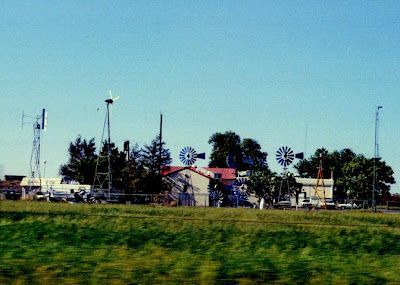
Wind turbines near Deming, New Mexico
The photo below shows that someone seems to be testing a variety of different types of wind-power generation equipment--both the traditional western windmill blade style as well as the more modern types of turbine fans. This shot was taken near Deming, New Mexico.


Solar Installations Near Denver, Colorado
The following two photos show the large photovoltaic array in front of the Denver International Airport. It's an impressive sight for arriving and departing travelers to see--a reminder about how available and accessible solar power really is!


The following two photos are from a housing area near Longmont, Colorado. Not sure whether the panel installation is for the neighborhood or for just one of the individual houses. Interesting to see, however.


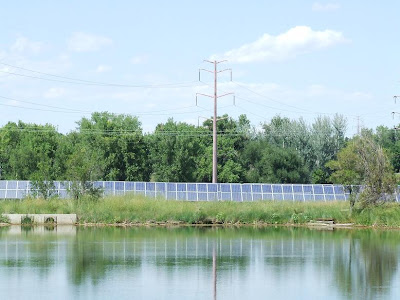
The following two photos are of a solar photovoltaic installation for a water treatment facility near Longmont, Colorado (north of Denver).



The following two photos are from a housing area near Longmont, Colorado. Not sure whether the panel installation is for the neighborhood or for just one of the individual houses. Interesting to see, however.


The following two photos are of a solar photovoltaic installation for a water treatment facility near Longmont, Colorado (north of Denver).


Saturday, June 5, 2010
Windmills on the Tehachapi Pass, California
After enjoying a weekend in Las Vegas, Nevada (a place that should be the home to SOLAR POWER!), we drove back to our Northern California home through the Tehachapi Pass Windmill farm -- and I had to stop and get a picture of some of the large wind turbines perched on the ridge of one of the hills by the road. We got there late, so I didn't have much sunlight to help with getting a picture (but at least it was cooler!).


Thursday, May 20, 2010
Watching Energy on Facebook!
If you are on Facebook, you can follow Tesla Motors and get the latest news from them as it develops. Lately, they've been showing enterprising folks using photovoltaic solar panels to cover the carport in which they park their Tesla roadster. They use the solar panels to recharge their car while it's parked. This is truly a great way to get oil out of the picture. Check out their site on Facebook!
Tesla and NUMMI - New Manufacturing! Great News!
News just came in that the old GM-Toyota NUMMI plant in Fremont, California, will be reopening as a manufacturing plant for Tesla Motors to produce the electric cars. Tesla is inspiring potential buyers around the world with demonstrations of their cars. In more ways than one--this is GREAT news! Not only will these non-oil-burning cars be made in higher numbers and with great efficiency (the factory is already set up to manufacture vehicles--so restructuring it and remachining it to make the electric cars won't be a major overhaul), but this will be a boost for employment in our area as well. When the NUMMI closed a few months ago, thousands of workers were dumped on the streets--not to mention the workers for the supporting industries. But now, those jobs will be filled again--so it will lessen the economic disaster our state has been experiencing.
Sunday, April 25, 2010
Solar Wine! (No, It's Not Like Solar Tea!)
We recently toured Napa Valley during a relatively sunny weekend. And I was impressed with the amount of alternate energy being used there. One vineyard and winery in particular caught my attention. Their solar array in the back of their winery was impressive (I don't drink -- can't for certain medical reasons. But I do enjoy sightseeing, photography, and investigating alternate energy technologies!) So, while my passengers were enjoying the goodies in the tasting room, I was enjoying getting pictures of the scenery and the solar technology--some of which is pictured here. Enjoy!

Solaron Grid-Tie PV Inverter http://www.aesolaron.com/

I did wonder, however, why the winery chose to place their solar panel array on the ground (which could have been used for growing grapes or olive trees or just providing green-space), rather than using it to provide a covered parking lot or placing it on the rooftops of their buildings. I would think that having the arrays used as the covering for a parking lot or on the rooftop would make panel maintenance a lot easier. Also, you wouldn't be risking damage from animals or falling trees and branches during storms. But then, I don't know their reasoning--but I liked what I saw anyway.


Solaron Grid-Tie PV Inverter http://www.aesolaron.com/

I did wonder, however, why the winery chose to place their solar panel array on the ground (which could have been used for growing grapes or olive trees or just providing green-space), rather than using it to provide a covered parking lot or placing it on the rooftops of their buildings. I would think that having the arrays used as the covering for a parking lot or on the rooftop would make panel maintenance a lot easier. Also, you wouldn't be risking damage from animals or falling trees and branches during storms. But then, I don't know their reasoning--but I liked what I saw anyway.

Wednesday, September 2, 2009
Retrofitting Factories, Retraining Workers - Why Not? Saves the Economy and Many Other Things!
The Toyota Motor Company has decided to close its New United Motor Manufacturing Inc. (NUMMI) Factory in Fremont, California, next year in March. This will put 4700 workers at the NUMMI plant on the streets without a job and the ripples from this will also zap 1000+ other companies that supply parts for the facility.
California officials had offered all sorts of financial incentives for the plant to remain open, but Toyota determined that it must close.
So now, we'll have a huge (5 million sq ft/300 acres) facility laying idle and we'll also have another devastating hit on the already trashed economy of the state. Because not only do all those 4700 workers spend their money here in local businesses (hair dressers/barber shops, movies, car dealerships, gas stations, clothing stores, restaurants, hardware stores, petshops, veterinarians, medical doctors, grocery stores, and so on), but they also pay taxes. If not making money, these folks don't spend it. Likewise, these cuts in spending after the folks get laid off will result in all the businesses they used to patronize also cutting back... and the ripple continues through to rip another hole in the economy.
Ya want numbers? The East Bay Economic Alliance said that the factory has a direct annual payroll of about $512 million. With an additional indirect payroll of $904 million. Estimates are that up to 50,000 jobs will be clobbered by this closing.
Okay. Toyota and GM don't want the place.
Great. While the iron is hot, let's have a new paradigm jump in here.
Example:
The Ford Motor Co. built the 160-acre, $50 million-dollar assembly plant that employed 4,000 in 1955 in Milpitas. The factory closed in 1983 after producing 4.7 million vehicles. But then, in 1994 it was "rehabilitated" and opened as a thriving mall--"The Great Mall"--a huge mall with clothing outlets, restaurants, Light-Rail Station Access, easily accessed from freeways (I-680/I-880) and city streets. These stores and other businesses in the mall provide the City of Milpitas with a tax base and the citizens of Milpitas and the surrounding areas with a convenient shopping area (remember, it's accessible by energy conserving Valley Transit Authority buses and Light Rail!).
But maybe we don't want another huge mall on the I-880 corridor. How about we keep the primary purpose of the facility intact. But why not retool the manufacturing equipment to help Tesla Motors produce their electric car? The NUMMI facility is already geared up to provide chassis, drive-train components, metal-bending/molding, and painting.
If cars and trucks are not that "interesting" or viable as options, the facility can also be adjusted to mass-produce on a huge-scale SOLAR PANELS, SOLAR EQUIPMENT, and so on. It's very close to companies in Silicon Valley who have the expertise in photovoltaics, silicon-chip manufacturing, alternate energy, and so on. So, why not get a consortium of investors and alternate energy moguls to buy into this thing? Perhaps even keeping all the workers there and letting them become co-owners? They can be retrained to use their equipment in a new way. They'd probably prefer that to going on unemployment or scrambling for new jobs elsewhere.
I'm just throwing this idea out there... it seems a shame that this huge facility with such manufacturing potential will be thrown into the trash heap.
Let's get more things pushing on this alternate use for the NUMMI plant!
California officials had offered all sorts of financial incentives for the plant to remain open, but Toyota determined that it must close.
So now, we'll have a huge (5 million sq ft/300 acres) facility laying idle and we'll also have another devastating hit on the already trashed economy of the state. Because not only do all those 4700 workers spend their money here in local businesses (hair dressers/barber shops, movies, car dealerships, gas stations, clothing stores, restaurants, hardware stores, petshops, veterinarians, medical doctors, grocery stores, and so on), but they also pay taxes. If not making money, these folks don't spend it. Likewise, these cuts in spending after the folks get laid off will result in all the businesses they used to patronize also cutting back... and the ripple continues through to rip another hole in the economy.
Ya want numbers? The East Bay Economic Alliance said that the factory has a direct annual payroll of about $512 million. With an additional indirect payroll of $904 million. Estimates are that up to 50,000 jobs will be clobbered by this closing.
Okay. Toyota and GM don't want the place.
Great. While the iron is hot, let's have a new paradigm jump in here.
Example:
The Ford Motor Co. built the 160-acre, $50 million-dollar assembly plant that employed 4,000 in 1955 in Milpitas. The factory closed in 1983 after producing 4.7 million vehicles. But then, in 1994 it was "rehabilitated" and opened as a thriving mall--"The Great Mall"--a huge mall with clothing outlets, restaurants, Light-Rail Station Access, easily accessed from freeways (I-680/I-880) and city streets. These stores and other businesses in the mall provide the City of Milpitas with a tax base and the citizens of Milpitas and the surrounding areas with a convenient shopping area (remember, it's accessible by energy conserving Valley Transit Authority buses and Light Rail!).
But maybe we don't want another huge mall on the I-880 corridor. How about we keep the primary purpose of the facility intact. But why not retool the manufacturing equipment to help Tesla Motors produce their electric car? The NUMMI facility is already geared up to provide chassis, drive-train components, metal-bending/molding, and painting.
If cars and trucks are not that "interesting" or viable as options, the facility can also be adjusted to mass-produce on a huge-scale SOLAR PANELS, SOLAR EQUIPMENT, and so on. It's very close to companies in Silicon Valley who have the expertise in photovoltaics, silicon-chip manufacturing, alternate energy, and so on. So, why not get a consortium of investors and alternate energy moguls to buy into this thing? Perhaps even keeping all the workers there and letting them become co-owners? They can be retrained to use their equipment in a new way. They'd probably prefer that to going on unemployment or scrambling for new jobs elsewhere.
I'm just throwing this idea out there... it seems a shame that this huge facility with such manufacturing potential will be thrown into the trash heap.
Let's get more things pushing on this alternate use for the NUMMI plant!
Wednesday, August 19, 2009
Oil Prices Heading Up Again? Car Manufacturers Get Bailout? Affect on Alternate Energy?
Well, you may have noticed that oil prices are going up again (after the nice drop back in October, November, and December of last year)... and, since the Feds (in the U.S.) have given bail-outs to the banks and the automotive manufacturers, they are still pushing the gas-guzzling monsters. Maybe oil prices have to exceed $90/barrel before the screaming and fussing will cause more interest in alternate energy.
Ever since I took classes in alternate energy and solar energy and environmental sciences back in the 1970s (yeah, I'm that old) at the University of Guam and the University of Hawaii Manoa Campus Guam Extension, I've had a continuing fascination with the alternatives to oil and coal and nuclear as energy sources. It's not that these three energy sources don't work... they do... but it's the end-result... what to do with the "left-overs" that is the major concern. With the first two options (oil and coal), these are non-renewable resources (and they also involve some pollution problems from more places than you'd expect).
With nuclear power, the quandry of what to do with the spent fuel, what to do with the depleted uranium or other fissionable products is the major concern. Also, you have issues with security, controls, earthquake and natural hazard/disaster risks in addition to the disposal and storage of the hazardous waste/byproducts.
So... what does that leave us with?
Wind power. Solar power (PV, concentrators, passive designs, etc). Hydro (river) power. Tidal power. Oceanic wave power. Ocean Thermal Energy Conversion (OTEC). Renewables in the form of easily grown, non-food plants (blue-green algae, shrubs, cellulosic alcohol conversion, etc.).
With existing homes and buildings... just replacing incandescent lighting with fluorescent or LED lighting can save a significant amount of money on power bills. Planting appropriate and strategically located shrubbery and vegetation can shield the building from winter winds and summer direct sunlight. Addition of solar-shield tint to windows (and perhaps overhang awnings) can also shield from direct solar heat coming in through those windows. Upgrading and repairing insulation on windows and doors. Adding photovoltaic panels to the energy sources for the structure can also save on power bills. Same with solar concentrator water/air heaters.
New structures should be required to use energy-efficient designs and construction--passive solar heating/cooling tromb walls, thermal mass, clerestory windows (properly positioned), under-floor heating/cooling equipment, architecturally integrated solar PV panels, LED lighting/skylights, proper insulation, and surrounding landscape design. And, maybe some integrated vertical-axis wind power generators (like the ones shown on the Hybrid Boat post I made a few weeks/months ago).
And, this is just the beginning. We need to rethink our views on automobiles and commuting. Why, in the age of the Internet, do we have to commute even 20 miles (let alone 50-80 miles) to a job? If we already do teleconferencing from a meeting room equipped with Skype or WebEx or Polycom with folks in other states (as well as other countries half a world away), why can't we do it from a home office (or local office within a mile or so from our home)? This not only ends traffic congestion, but it gives us less stress and allows us to be more productive. We need to get back to the concept of working in our own town ... In my town, a fellow has set up a "Virtual Office" where for a minimal fee teleworkers can set up their laptops and either work in an enclosed office (with a door) or in a communal area. The "Virtual Office" provides free WiFi, Coffee, sometimes donuts (!), and a pleasant place to work where we don't have to drive far to get there.
This should be the new paradigm of work. We can produce the same if not more valuable product without having to eat up oil resources and automotive time/equipment to do it.
Ideas?
Ever since I took classes in alternate energy and solar energy and environmental sciences back in the 1970s (yeah, I'm that old) at the University of Guam and the University of Hawaii Manoa Campus Guam Extension, I've had a continuing fascination with the alternatives to oil and coal and nuclear as energy sources. It's not that these three energy sources don't work... they do... but it's the end-result... what to do with the "left-overs" that is the major concern. With the first two options (oil and coal), these are non-renewable resources (and they also involve some pollution problems from more places than you'd expect).
With nuclear power, the quandry of what to do with the spent fuel, what to do with the depleted uranium or other fissionable products is the major concern. Also, you have issues with security, controls, earthquake and natural hazard/disaster risks in addition to the disposal and storage of the hazardous waste/byproducts.
So... what does that leave us with?
Wind power. Solar power (PV, concentrators, passive designs, etc). Hydro (river) power. Tidal power. Oceanic wave power. Ocean Thermal Energy Conversion (OTEC). Renewables in the form of easily grown, non-food plants (blue-green algae, shrubs, cellulosic alcohol conversion, etc.).
With existing homes and buildings... just replacing incandescent lighting with fluorescent or LED lighting can save a significant amount of money on power bills. Planting appropriate and strategically located shrubbery and vegetation can shield the building from winter winds and summer direct sunlight. Addition of solar-shield tint to windows (and perhaps overhang awnings) can also shield from direct solar heat coming in through those windows. Upgrading and repairing insulation on windows and doors. Adding photovoltaic panels to the energy sources for the structure can also save on power bills. Same with solar concentrator water/air heaters.
New structures should be required to use energy-efficient designs and construction--passive solar heating/cooling tromb walls, thermal mass, clerestory windows (properly positioned), under-floor heating/cooling equipment, architecturally integrated solar PV panels, LED lighting/skylights, proper insulation, and surrounding landscape design. And, maybe some integrated vertical-axis wind power generators (like the ones shown on the Hybrid Boat post I made a few weeks/months ago).
And, this is just the beginning. We need to rethink our views on automobiles and commuting. Why, in the age of the Internet, do we have to commute even 20 miles (let alone 50-80 miles) to a job? If we already do teleconferencing from a meeting room equipped with Skype or WebEx or Polycom with folks in other states (as well as other countries half a world away), why can't we do it from a home office (or local office within a mile or so from our home)? This not only ends traffic congestion, but it gives us less stress and allows us to be more productive. We need to get back to the concept of working in our own town ... In my town, a fellow has set up a "Virtual Office" where for a minimal fee teleworkers can set up their laptops and either work in an enclosed office (with a door) or in a communal area. The "Virtual Office" provides free WiFi, Coffee, sometimes donuts (!), and a pleasant place to work where we don't have to drive far to get there.
This should be the new paradigm of work. We can produce the same if not more valuable product without having to eat up oil resources and automotive time/equipment to do it.
Ideas?
Saturday, August 1, 2009
Great Listing of Alternate Energy Jobs!
I haven't been posting here regularly lately ... sorry about that. Been keeping busy with editing/writing jobs (that is what my real job is--I am a technical editor/writer for high-tech companies and clients).
Anyway, I found a website that posted a cool list of alternate energy jobs:
http://www.mywindpowersystem.com/2009/05/a-guide-to-renewable-energy-jobs-a-look-at-the-wind-power-industry/
If you are interested in alternate energy jobs, this is a good compilation of what you can find out there. These jobs are the wave of the future!
Best of luck to all of you.
Anyway, I found a website that posted a cool list of alternate energy jobs:
http://www.mywindpowersystem.com/2009/05/a-guide-to-renewable-energy-jobs-a-look-at-the-wind-power-industry/
If you are interested in alternate energy jobs, this is a good compilation of what you can find out there. These jobs are the wave of the future!
Best of luck to all of you.
Thursday, July 9, 2009
Windpower Gaining Interest on Guam!
This is an interesting YouTube Video of a Wind Generator installed at a home on the Western Pacific island of Guam. Note that the speakers also mention the solar water heater! What a great way to save on power bills! (Also, since the power frequently goes out on Guam due to all sorts of factors--with sometimes the blame going to the brown tree snake, Boiga irregularis -- having your own source of power is a very convenient thing!)
Saturday, June 27, 2009
Upcoming PV Conference in San Francisco - July 14, 2009
"The Solar Future; A realistic approach to California's PV market opportunities" conference in will be held in San Francisco, California in a few weeks on July 14, 2009--during the same week as the "Intersolar North America" conference. Experts from the field will discuss barriers to market entry, incentives schemes and their practical experiences.
Guest speakers include:
Sue Kateley; Executive Director of CALSEIA (California Solar Energy Industry Association)
David Rubin; Director at PG&E and Chairman Board of Directors, Solar Electric Power Association (SEPA)
David Devir; Vice President of Technology, SunCentric
Barry Cinnamon; CEO and founder of Akeena Solar
Andrew Beebe; Vice President, Global Product Strategy of Suntech Power
Glenn Harris; CEO of SunCentric
Lyndon Rive; CEO of SolarCity
Hugh Kuhn; Vice President, Operations and Technology of Solar Power Partners
For this conference, companies with an innovative product or service that will help to bring down the cost of a Balance Of Systems are invited to pitch their product.
Interested companies should contact Solarplaza to find out more.
This invite came from:
Johan Trip
CGO Solarplaza
+31 10 280 9198
j.trip@solarplaza.com
www.thesolarfuture.com
Guest speakers include:
Sue Kateley; Executive Director of CALSEIA (California Solar Energy Industry Association)
David Rubin; Director at PG&E and Chairman Board of Directors, Solar Electric Power Association (SEPA)
David Devir; Vice President of Technology, SunCentric
Barry Cinnamon; CEO and founder of Akeena Solar
Andrew Beebe; Vice President, Global Product Strategy of Suntech Power
Glenn Harris; CEO of SunCentric
Lyndon Rive; CEO of SolarCity
Hugh Kuhn; Vice President, Operations and Technology of Solar Power Partners
For this conference, companies with an innovative product or service that will help to bring down the cost of a Balance Of Systems are invited to pitch their product.
Interested companies should contact Solarplaza to find out more.
This invite came from:
Johan Trip
CGO Solarplaza
+31 10 280 9198
j.trip@solarplaza.com
www.thesolarfuture.com
Wednesday, May 27, 2009

This is a wind turbine generator we saw in Deming, New Mexico just off the freeway at a rest stop. Interesting contraption. Inspirational to see how it had been erected and tied down. And it was fun thinking of other possibilities for a device like this in other places around the world. Note that unlike most of the other wind power generators, this device has only two blades opposite each other on the shaft (rather than the usual three blades). I wonder if this increases or decreases efficiencies.
Friday, May 22, 2009
Mini Wind Generator for Charging Your Portable Devices!
Just saw this come over the "wires"... A miniature wind generator for charging your portable devices.
Interesting. I can see it being used when out driving and your cell phone is starting to die and you haven't brought your car-charger. Just hold this thing out the window as you're driving (have your passenger do it, you shouldn't be doing this yourself as you drive). HYMini claims that you can use it on your bicycle, or when boating or skiing. Makes sense. I live in a really windy area of the country (and, no, I don't mean all the politicians, but that's also a factor)--might be able to set this up on a window sill and charge my devices that way.
Interesting. I can see it being used when out driving and your cell phone is starting to die and you haven't brought your car-charger. Just hold this thing out the window as you're driving (have your passenger do it, you shouldn't be doing this yourself as you drive). HYMini claims that you can use it on your bicycle, or when boating or skiing. Makes sense. I live in a really windy area of the country (and, no, I don't mean all the politicians, but that's also a factor)--might be able to set this up on a window sill and charge my devices that way.
Wednesday, May 6, 2009
The only hybrid vessel in the United States?
As I mentioned in my previous post, I did some digging and got some more information about that interesting "Hybrid Boat" I saw when I was walking along the piers in San Francisco. Here are some more specifics:
Previously used as a commercial diving boat, the Hornblower Hybrid is a 64ft catamaran with a fully-enclosed main deck and a covered roof deck. The boat, which has a capacity of 149 passengers, underwent retrofitting, repowering, and refurbishing in Sausalito to be more energy-efficient and environmentally friendly. The boat was originally put into service as a dive platform in the Gulf... then purchased and moved to Sausalito for its most recent transformation.
Most noticeable about the boat are the twin 10ft-tall wind turbines (1.2 KW normal output, 2.0 KW max.) and a photovoltaic solar array (1.2 KW) covering the awning on the top deck. These two features (turbines and PV array) provide energy that is stored in battery banks that power the navigation tools, lighting, and other electronics on the boat. Excess power is stored in the main propulsion battery banks.
For propulsion, the boat uses two Series 60 MTU Tier 2 marine diesel engines that are fuel-efficient and cleaner, thus reducing the amount of diesel fuel required and reducing emissions. These diesel engines are run two Marathon 320 KW generators that send the power to two Yosukawa variable frequency drives that control the output of two 400 horsepower electric motors connected directly to conventional propellers. This customized drive system allows the captain to monitor the boat's energy needs and select the most efficient power sources (for example, when the boat is idle at the dock, the engines shut down and the motors run off energy stored in the battery banks). A 380V DC battery bank allows a "zero-emission mode" to be used.
Lighting throughout the boat is Light-Emitting-Diode (LED), which requires a fraction of the energy required by standard bulbs to provide equal or more illumination. The LEDs also require less maintenance time and trouble.
This boat was purchased, refurbished, and put into service by Hornblower's Alcatraz Cruises--no grant or public money was used in the boat's redesign and refurbishment.
Hornblower's Alcatraz Cruise on the Hybrid website has a description of the service that this craft is being used for and also has an Excellent Diagram Showing the Basic Schematics of the Hybrid Vessel.
You can see this interesting vessel in person at the Alcatraz Landing at Pier 33 in San Francisco, CA.
Previously used as a commercial diving boat, the Hornblower Hybrid is a 64ft catamaran with a fully-enclosed main deck and a covered roof deck. The boat, which has a capacity of 149 passengers, underwent retrofitting, repowering, and refurbishing in Sausalito to be more energy-efficient and environmentally friendly. The boat was originally put into service as a dive platform in the Gulf... then purchased and moved to Sausalito for its most recent transformation.
Most noticeable about the boat are the twin 10ft-tall wind turbines (1.2 KW normal output, 2.0 KW max.) and a photovoltaic solar array (1.2 KW) covering the awning on the top deck. These two features (turbines and PV array) provide energy that is stored in battery banks that power the navigation tools, lighting, and other electronics on the boat. Excess power is stored in the main propulsion battery banks.
For propulsion, the boat uses two Series 60 MTU Tier 2 marine diesel engines that are fuel-efficient and cleaner, thus reducing the amount of diesel fuel required and reducing emissions. These diesel engines are run two Marathon 320 KW generators that send the power to two Yosukawa variable frequency drives that control the output of two 400 horsepower electric motors connected directly to conventional propellers. This customized drive system allows the captain to monitor the boat's energy needs and select the most efficient power sources (for example, when the boat is idle at the dock, the engines shut down and the motors run off energy stored in the battery banks). A 380V DC battery bank allows a "zero-emission mode" to be used.
Lighting throughout the boat is Light-Emitting-Diode (LED), which requires a fraction of the energy required by standard bulbs to provide equal or more illumination. The LEDs also require less maintenance time and trouble.
This boat was purchased, refurbished, and put into service by Hornblower's Alcatraz Cruises--no grant or public money was used in the boat's redesign and refurbishment.
Hornblower's Alcatraz Cruise on the Hybrid website has a description of the service that this craft is being used for and also has an Excellent Diagram Showing the Basic Schematics of the Hybrid Vessel.
You can see this interesting vessel in person at the Alcatraz Landing at Pier 33 in San Francisco, CA.
Thursday, April 30, 2009
Hybrid Boats? Yup, They're Out There!

While wandering around the piers in San Francisco the other day I came across a boat that sported the label "Hybrid"... Of course, I had to take a closer look and perhaps get a picture or two of this interesting contraption.
I'm not sure what aspect of the boat was "hybridized"--Were the wind-generators on the top deck powering the whole ship or providing only electricity for charging the batteries to power the lighting and perhaps other minor electrical devices on the craft? I would have asked any Hornblower crew around if I could have found one. I'll update here if I get this information. This is an example of wind-energy powering a boat but the boat is obviously NOT a sailboat.
.
Thursday, April 23, 2009
Inside Workings of an Electric Vehicle

If you've ever wondered what the innards of an electric vehicle (non-hybrid) looked like, here's a view. Pictured under the raised bed of this Xebra Zaptruck pickup is the bank of 6 lithium batteries; the QuiQ HF/PFC Battery Charger from Delta-q Technologies in Burnaby, BC, Canada; the electric motor (next to the spare tire); and the DC Motor Controller. The batteries are connected in serial fashion through the DC Motor Controller which controls the torque/movement of the electric motor. According to the rep I talked to, the vehicle has a range of 25 miles after a 5-hour charge. It has a top speed of about 40mph. It is considered a "motorcycle" by California DMV (because it has only 3 wheels). It is for city streets only--you don't want to take this onto a freeway or expressway.
 This is where you plug in the cord to charge the batteries. When closed, it looks like the standard fuel port for any kind of car.
 This is the QuiQ HF/PFC Battery Charger -- through a connector/outlet where the gas refill port might be, it charges using a standard 110v extension cord connection.
 This is one end of the DC Motor Controller (with connections to the batteries and the control panel in the passenger compartment).
Thursday, April 16, 2009
Windmills on Altamont Pass, California
Now these are the huge windmills that generate lots of electricity to be fed into the power grid. Can you imagine if parking lots had windpower generating units in addition to photovoltaic panels on the light poles with plug-in outlets at the bases of the light poles (or at the tire-stops for each designated parking space)? You could drive plug-in-hybrid-electric vehicles (PHEVs) and not only save energy, but also have enough juice to be going all the time. Parking lots are sort of "wasted space" anyway. The cars sit out there all day and absorb the sun's rays (and maybe become useful as "solar cookers"!), but with the combination of solar panels on the cars' roofs as well as solar panels on the parking lot light poles, there could be some collection of that incoming solar radiation. With small wind generators also attached to the light poles (being that they are high enough off the ground to snag the ambient breezes), you could charge PHEVs both night and day. Guess what? Gas prices are starting to inch their way back up again.... so maybe those hybrids such as the Honda Accord and the Toyota Prius and the others out there might be looking like good investments again.
Wednesday, April 15, 2009
Solar Water/Air Heating Facility Schematic

This is a schematic for a solar water/air heating facility in Alamogordo, New Mexico. I had a tour of this facility when I was working as a writer/photographer for the local daily newspaper. The interior of the actual facility is shown below.

.
Wednesday, March 11, 2009
Santa Barbara, California, Dedicates Their Solar Power System Today, March 11, 2009
Santa Barbara, California, dedicates their solar power system today, March 11, 2009 with a ceremony and educational tour from 2:00pm through 3:00pm in the David Gebhard Meeting Room, at 630 Garden Street.
Santa Barbara's City Corporate Yard solar system can produce 550,000 kWh of energy per year, effectively offsetting 421,466 lbs, or 191 metric tons, of carbon dioxide emissions. Similarly equal to removing about 35 cars from the road, saving 21,328 gallons of gasoline, or powering over 100 Santa Barbara-area homes a year (based on a single family occupancy energy use of 5,000 kWh per year). And of course, reducing the City's need for power grid use (and their subsequent power bills)!
The solar power system, spread among the Corporate Yard's roofs, was installed through a partnership of Suntech Power Holdings Co., Ltd and Tioga Energy in which the City of Santa Barbara. The system was installed over a three-month period in the last part of 2008.
To read more about this event, see the event press release.
.
Santa Barbara's City Corporate Yard solar system can produce 550,000 kWh of energy per year, effectively offsetting 421,466 lbs, or 191 metric tons, of carbon dioxide emissions. Similarly equal to removing about 35 cars from the road, saving 21,328 gallons of gasoline, or powering over 100 Santa Barbara-area homes a year (based on a single family occupancy energy use of 5,000 kWh per year). And of course, reducing the City's need for power grid use (and their subsequent power bills)!
The solar power system, spread among the Corporate Yard's roofs, was installed through a partnership of Suntech Power Holdings Co., Ltd and Tioga Energy in which the City of Santa Barbara. The system was installed over a three-month period in the last part of 2008.
To read more about this event, see the event press release.
.
Wednesday, March 4, 2009
Oil? What Oil? Crisis? What Crisis? How about a NEW GAME?

It's a game of supply and demand. And sometimes, like when playing poker, you have to know when to hold them and know when to fold them. (Or pack up your game, and just go home; or create a new game with new rules!) Depending on who you talk to, we're facing an oil crisis. Or, maybe we aren't. We're facing an environmental crisis. Maybe we aren't. Go figure. Maybe we should ignore all the idiot economists and news media out there (because all we get are conflicting reports) and just happily move on and tinker with our own ways to beat the power grid and gain independence from oil companies, power companies, and so on. A few photovoltaic panels on the roof, a solar water heater, a solar air heater, a plug-in hybrid electric vehicle that uses vegetable oil for the non-electric need for locomotion... and *voila!*... no need for the oil company or the power company.
Okay, last year we were watching the price per barrel of oil heading past $140. And gas prices at the pump in the U.S. were reaching almost $5 per gallon.
Folks were bailing out of their Ford Excursions and Expeditions, their Chevy Suburbans, their Yukons, their Hummers, and all the other gas-hog vehicles and were running to Toyota, Honda, Nissan, and Hyundai (to name a few)--folks who still seemed to know how to make more efficient and energy-conserving vehicles.
The hybrid-electric-vehicles (HEV) and even more energy-effective plug-in-hybrid-electric-vehicles (PHEV) were getting rave reviews and more demand than ever. There were waiting lists at all the dealerships to get these cars.
Although folks were backing away from doing much unnecessary driving and thus not buying as much of the $5/gallon fuel, oil companies posted their highest profits for the quarters of 2007-2008. They were making gravy!
In the meantime, the big car companies (Ford, GM, Chrysler) were taking the hits. They didn't see the writing on the wall. They were (and still are) losing billions of dollars.
What's funny is that in 1980, I took some classes on alternate energy and energy conservation at the University of Guam and the University of Hawaii... and they were preaching that we would run out of oil totally by the year 2000. After the scares of the oil crisis in 1973-1974... when OPEC started to get squirrely, the "oil crisis" and "energy conservation" was still clear on our minds. We knew we were dependent on oil (in more ways than one). And for Guam and Hawaii, any oil for fuel or otherwise had to be shipped in. It wasn't as if we had our own sources. We did, however, have abundant Solar Energy and other renewable and alternate energy sources. And that's the point.
I bought a used Datsun 1200 sedan for that reason. Yeah, I could have gone for a used Ford LTD or a Mustang Mach II or an Olds GTO... but, hey, I lived on Guam... and the Japanese cars didn't seem to rust out as much as the U.S. cars did. And also, it wasn't like I was going to do any major highway driving. That Datsun (now Nissan) got up to 48 miles per gallon... great for a college kid on a limited budget.
So, I saw in today's news that there are more than 30 tankers -- each with the capacity of 2 million barrels of oil sitting anchored offshore around the world. They are "floating storage tanks" and they are sitting idle... waiting for the prices of oil to go up. Storage farms in the U.S. are at capacity. Refineries have cut back on production. Because the demand disappeared. The recession wiped out jobs. Without jobs, folks don't need to drive very much. Thus, less demand on oil.
Prices of oil plummeted from about $5 a gallon back in August 2008 to about $1.65 a gallon by October/November 2008. (Didn't matter to me... because I got laid off in September Sigh). Now the oil prices have edged back up to about $2.20 a gallon (These are all Northern California prices... your "milage may vary" depending on your location).
But the price per barrel of oil still remains at about $40, far down from its price of over $140 back in August. At the time, traders were counting on the price-per-barrel to exceed $200. Well... like I said at the beginning. The utilities market and the commodities markets are like a poker game. Sometimes ya win, sometimes ya lose. Or, sometimes, you create a new game and change the rules.
That's what we must do. We must, as individuals, create our own NEW GAME! Keep on tinkering with our home-made "franken-sources" for energy. Our home-built solar panels, home-built solar water heaters, home-built solar air heaters, solar greenhouses, better insulation, better weather-stripping, better driving habits, better and wiser purchases for home use. We can not only change the rules of the game, but create a new game. And not become dependent on the knuckleheads that have huge, heavily ladden oil tankers sitting idle off our coasts waiting for the price to rise so they can gouge us again.
Have we learned any lessons yet?
Subscribe to:
Posts (Atom)


 Posts
Posts

